Heat Press vs Lamination: Which One Is The Best For Your Campaign?
You are holding two supplier quotations for custom bags: one quoting "heat transfer printing" at RM1.50, the other quoting "laminated printing" at RM3.00. These are two different methods.
Heat transfer printing applies a pre-printed design onto part of the bag using heat and pressure, ideal for multi-colour logos at 300 to 2,000 pieces.
Laminated printing bonds a full-colour BOPP (biaxially oriented polypropylene) film across the entire bag surface via rotogravure, delivering edge-to-edge designs at MOQs of 3,000+ pieces. They are not quality tiers; they are different tools for different campaigns.
This guide compares both as bag-production methods for bulk custom orders, not as DIY machine alternatives for document laminating. The right choice depends on three variables: your order quantity, your design coverage, and how long the bag needs to last.
Key Takeaways
- Heat transfer printing applies a pre-printed design onto part of the bag surface. Best for multi-colour logos at MOQs of 300 to 2,000 pieces. Faster turnaround, no plate costs.
- Laminated printing bonds a full-colour BOPP film across the entire bag via rotogravure. Best for edge-to-edge retail-grade designs at MOQs of 3,000+ pieces. Superior long-term durability.
- "Laminated bag" and "laminated printing" are not the same thing. One is the bag's surface finish. The other is the printing process.
- Decision rule: If your design covers a partial area and your order is under 2,000 pieces, choose heat transfer. If your design covers the entire bag and your order exceeds 3,000 pieces, choose laminated printing.
- Screen printing remains the most economical method for simple 1- to 2-colour logos at high volumes.
Stop Confusing "Laminated Bag" With "Laminated Printing"

“Laminated bag” and “laminated printing” describe two completely different things. Getting this wrong is how first-time bulk orders go sideways.
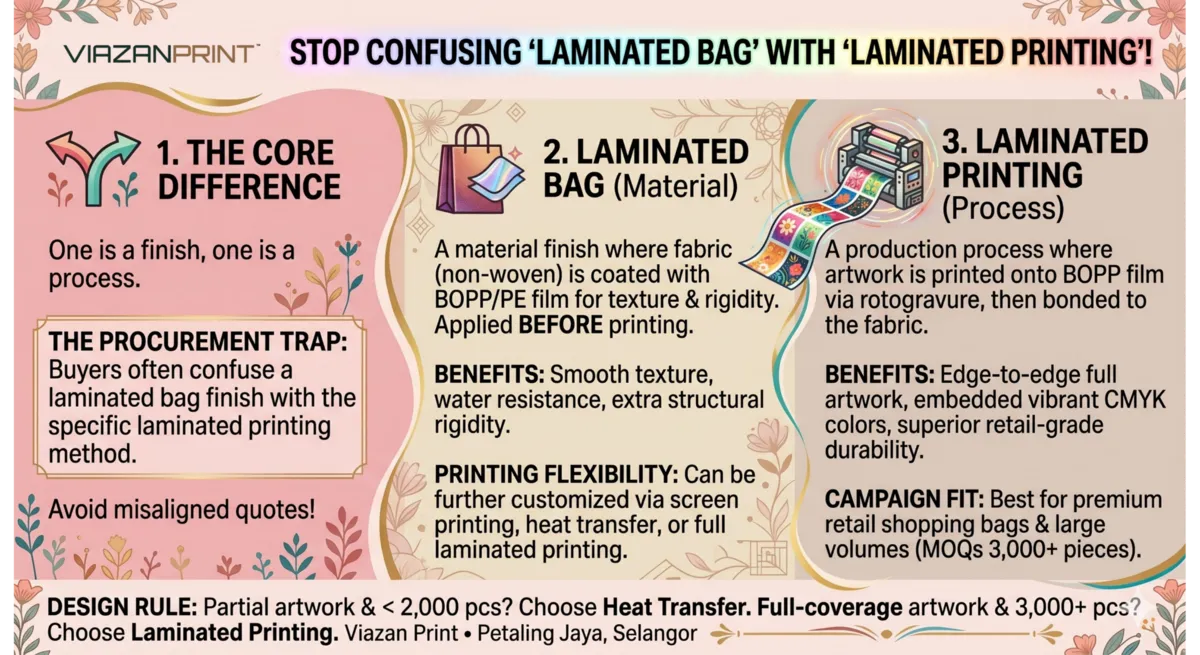
When a buyer asks for “laminated bags with my logo” without specifying the printing method, suppliers interpret this differently. Some quote a laminated-surface bag with screen-printed artwork. Others quote the full rotogravure process.
This is how you end up comparing quotations for what you think is the same product, only to receive something entirely different. Even experienced procurement managers confuse these terms. The industry itself uses “laminated” loosely on product pages and quotation forms.
Read our guide on laminated non-woven bags and their benefits for more on how the surface finish affects durability. For a broader technical reference, see Yanxin Bag’s explainer on non-woven bag printing techniques.
Head-to-Head: Heat Transfer Printing vs Laminated Printing
Heat transfer and laminated printing differ across eight key criteria. This comparison covers the variables that matter most for bulk bag orders in Malaysia.
Criteria | Heat Transfer Printing | Laminated Printing | Best For |
Process | Design printed onto transfer film, then heat-pressed onto bag | Design printed onto BOPP film via rotogravure, then heat-bonded to fabric | Heat transfer for speed; laminated for integration |
Colour range | Unlimited colours, gradients, photographic images | Full-colour CMYK via rotogravure | Both handle multi-colour well |
Design coverage | Partial area (one face or panel) | Full bag surface, edge to edge | Heat transfer for logos; laminated for all-over branding |
MOQ | 300 to 500 pieces | 3,000 to 5,000 pieces | Heat transfer for smaller orders |
Durability | Durable under normal use; may wear under heavy daily reuse | Embedded within BOPP film; resists scratching, moisture, fading for 50+ reuses | Laminated for retail |
Texture/finish | Retains non-woven fabric texture | Smooth, glossy or matte retail-grade finish | Laminated for premium feel |
Cost driver | Proportional to quantity; no plate setup cost | Front-loaded in rotogravure plate production | Heat transfer below 2,000 pcs |
Lead time | Samples in 1 to 2 working days | Plates must be engraved and approved first | Heat transfer for tight deadlines |
MOQ is the deal-breaker for most buyers. At 500 to 1,000 pieces, laminated printing is prohibitively expensive because the cost of rotogravure plates is spread across too few bags.
Design coverage is the practical decision point: a logo on one panel suits heat transfer; all-over branding requires a laminate. Durability depends on reuse: event bags suit heat transfer; retail bags reused weekly justify laminated printing.
Browse Viazan Print’s colour chart for available options. For a broader overview of printing methods, see ODM Group’s full guide to bag printing methods and KETE Group’s explainer on how laminated printing works on non-woven bags.
Five Bags for Five Cafe Scenarios
Laminated printing costs more because of one thing: rotogravure plates. These engraved metal cylinders are expensive to produce and must be made before any printing begins. The plate cost is fixed regardless of order size. At 500 bags, the cost per unit is steep. At 5,000, it becomes negligible.
Heat transfer has no fixed setup cost
Designs are printed onto transfer film using digital or offset printing. Cost scales proportionally with quantity, making it viable at 300 to 500 pieces. For a Malaysian pricing reference, see Greenworks' page on heat transfer printing for non-woven bags in Malaysia.
The crossover point
Sits at approximately 3,000 to 5,000 pieces, where laminated printing's per-unit cost approaches that of heat transfer while delivering a superior finish.
Re-orders change the equation further
Once plates are produced, they are stored and reused, so subsequent orders skip plate production entirely.
Red flag: if a supplier quotes "laminated printing" at 300 to 500 pieces, they may be quoting heat transfer on a laminated-surface bag, not the full rotogravure process. Always confirm what the quotation covers.
Which Method Fits Your Campaign?
The right method depends on what your bags need to accomplish. Use the guide below to match your campaign to the method that delivers the best result.
Campaign Type | Recommended Method | Typical Volume | Key Reason |
Trade show / exhibition | Heat transfer | 500 to 2,000 pcs | Shorter lead time. Partial-area logos. Budget-friendly. |
Retail shopping bag | Laminated printing | 5,000 to 20,000 pcs | Edge-to-edge branding. Retail finish. Maximum durability. |
Corporate gift | Depends on quantity | 300 to 1,000: heat transfer. 3,000+: laminated | Heat transfer for logos. Laminated for all-over branding. |
University event | Heat transfer | 500 to 2,000 pcs | Multi-colour logos. Fixed budgets. Faster turnaround. |
FMCG promotional (Raya, CNY) | Laminated for 5,000+; heat transfer for 500 to 1,000 | Varies | Factor in longer lead time for laminated if ordering for festive seasons. |
Three-variable decision summary:
- Order volume. Below 2,000 favours heat transfer. Above 3,000 makes laminated viable.
- Design coverage. Partial area favours heat transfer. Full coverage requires a laminated.
- Reuse expectation. Short-term suits heat transfer. Long-term justifies laminated.
Non-woven bags are a proven sustainable alternative to plastic bags across all campaign types. Explore Viazan Print’s non-woven bag options to see materials suited to each scenario.
Where Does Screen Printing Fit In?
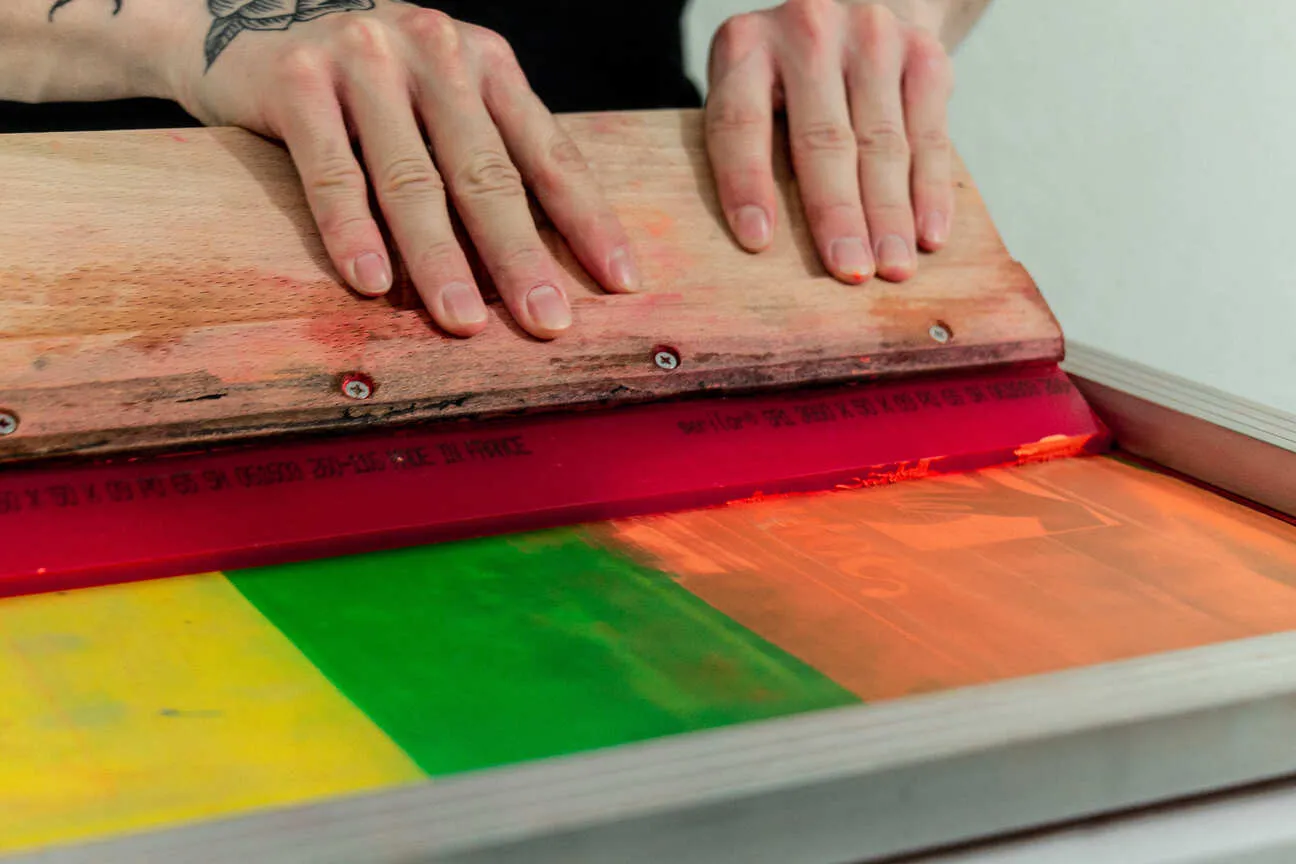
Screen printing remains the most economical method for simple 1- to 2-colour logos at high volumes. For 1,000+ plain non-woven bags with a straightforward design, it is hard to beat on cost.
Screen printing is not suitable for gradients, photographs, or complex multi-colour artwork. It performs best on porous surfaces: plain non-woven polypropylene and cotton canvas. For canvas options, explore Viazan Print’s canvas bag options.
We recommend screen printing when it fits. There is no reason to pay more for heat transfer when a single-colour logo on a 90 GSM non-woven bag will look just as sharp. For a detailed comparison, see Initi Packing’s guide on screen printing vs heat transfer for custom bags.
Browse our list of trending promotional product ideas for inspiration on using screen-printed bags.
Why Viazan Print
Viazan Print produces heat transfer, laminated, and screen-printed bags daily from our facility in Petaling Jaya, Selangor. We are the factory.
- All three printing methods in-house, so recommendations are based on what fits, not what we stock.
- 100 GSM standard non-woven fabric across all bag types.
- 5 working days production for orders under 10,000 pieces; 8 working days for 10,000 to 20,000 pieces.
- Transparent quoting: We break down plate cost, printing cost, and material cost separately.
Conclusion
Heat transfer and laminated printing are not interchangeable. If your design covers a partial area and your order is under 2,000 pieces, heat transfer is the better fit. If your design covers the entire bag and your order exceeds 3,000 pieces, laminated printing delivers a retail-grade result that justifies the cost of the plate.
Specify your order volume, design coverage, and reuse expectations when requesting a quotation, and your supplier can recommend the most suitable method.
FAQ
Is heat press the same as heat transfer printing?
No. A heat press is the machine. Heat transfer printing is the method that uses a heat press to bond a pre-printed design onto fabric. "Heat press printing" is industry shorthand, but "heat transfer printing" is the precise term.
What is the minimum order for laminated printing on non-woven bags?
Laminated printing typically requires 3,000 to 5,000 pieces due to the cost of rotogravure plates. For orders of fewer than 2,000 pieces, heat transfer is more cost-effective.
Can I get a sample before placing a bulk order?
For heat transfer, a physical sample can typically be produced within 1-2 working days. For laminated printing, a digital mockup is standard; producing a physical sample requires first producing the rotogravure plate. Ask whether the sample plate cost is credited toward the bulk order.
Will heat transfer printing peel off after multiple uses?
Modern heat transfer printing is durable on non-woven polypropylene when applied correctly. Peeling typically results from incorrect application settings. For bags reused weekly over months, laminated printing offers superior durability because the design is embedded within the BOPP film layer.
Can I combine lamination with heat transfer on the same bag?
Yes. You can produce a laminated non-woven bag (for water resistance and rigidity) and apply a heat transfer design on the laminated surface. This gives structural benefits of lamination with design flexibility of heat transfer.